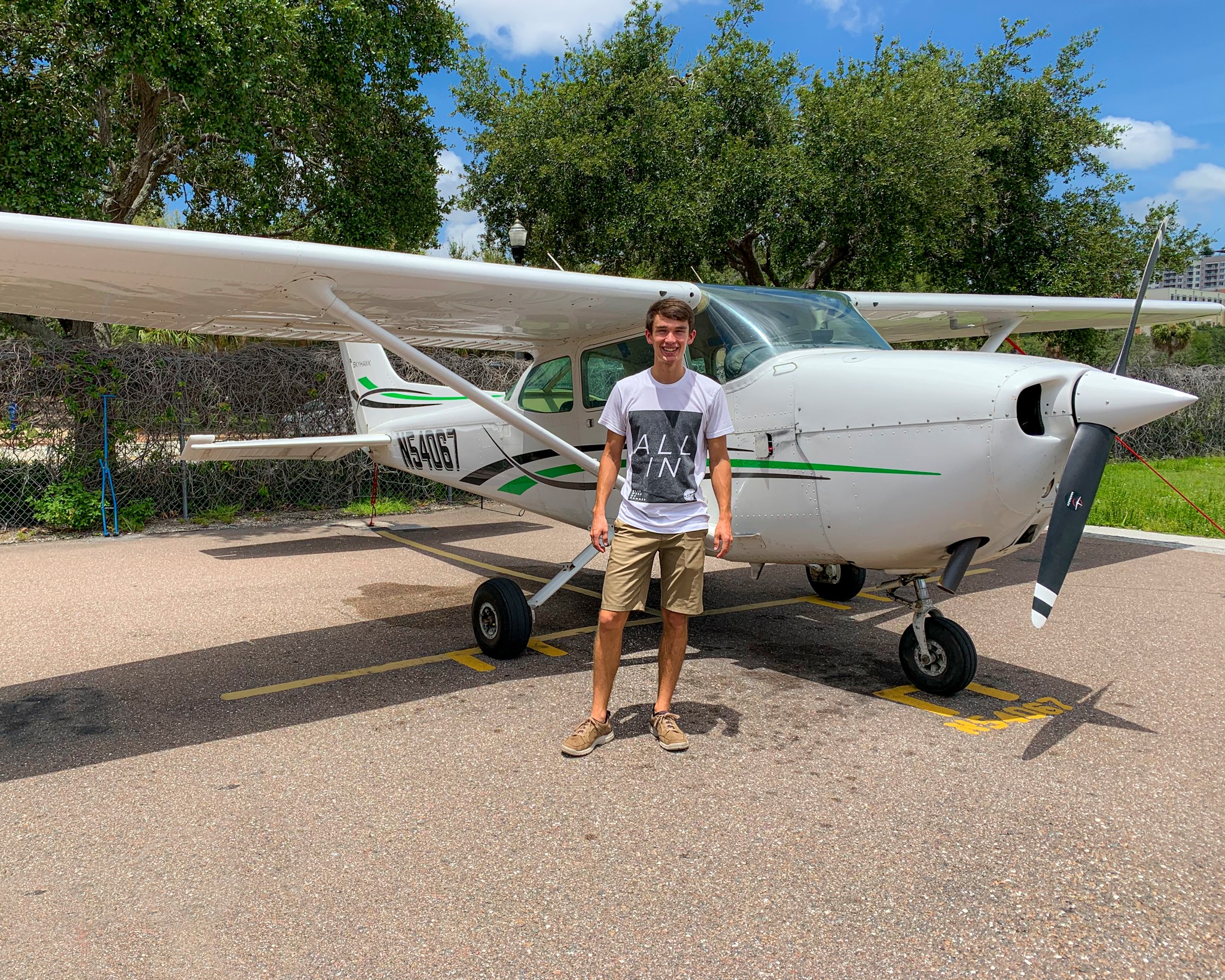
Take the controls of one of our primary flight training aircraft with a Certified Flight Instructor on a flight around the St. Pete area and determine if the path of aviation is for you!
FLIGHT TRAINING
St. Pete Air offers flight training under F.A.R. Part 61 criteria for all ratings.
If you’re interested in becoming an aviator, our friendly staff is dedicated to making it happen.

Our flight school is staffed with instructors who have both trained and conducted training in the Tampa Bay area, having logged many hours training student pilots locally. Our instructors can customize your learning experience to suit your personal needs, whether your goal is to begin a career in aviation and take an accelerated path towards the commercial level, or to fulfill your dream of becoming a private pilot at your own pace.
St. Pete Air offers flight training under F.A.R. Part 61 criteria for all ratings. Our primary training fleet consists of a Diamond DA40, Cessna 172M&P, and Piper Archer/Arrow models equipped with Garmin GNS-430 GPS systems. All aircraft are equipped with state-of-the-art Traffic Awareness Systems to provide you with the highest level of safety.
St. Pete Air offers flight training under F.A.R. Part 61 criteria for all ratings. Our primary training fleet consists of a Diamond DA40, Cessna 172M&P, and Piper Archer/Arrow models equipped with Garmin GNS-430 GPS systems. All aircraft are equipped with state-of-the-art Traffic Awareness Systems to provide you with the highest level of safety.
Certificates & Ratings Offered
Commercial Pilot
Certified Flight Instructor
Certified Instrument Instructor
Private Pilot
Instrument Pilot
Multi Engine
High Performance Rating
Complex Rating
Tail Wheel Endorsement
FAA Private Pilot Requirements
The FAA requires a minimum of 40 hours with each criteria met below. Most students finish their requirements in 50-60 hours. Our instructors will work with you to meet your timeline and goals.
General
- Be at least 17 years of age. Students may begin training prior to this as young as 14.
- Be able to read, write and converse fluently in English.
- Obtain at least a third class medical certificate from an Aviation Medical Examiner
- Pass a computerized aeronautical knowledge test at an FAA-designated computer testing center with a score of 70 or higher
- Accumulate and log flight experience (FAR 61.109). Receive a minimum of 40 hours of flight instruction and solo flight time including:
Solo Requirements
- 10 total hours of which 5 must be solo cross-county time
- One solo cross-country flight of at least 150 nmi (280km) total distance, with full-stop landings at a minimum of 3 points and with at least one segment of the flight consisting of a straight-line distance of at least 50nmi (93km) between the takeoff and landing locations
- Three solo takeoffs and landings to a full stop at an airport with an operating control tower
Night Requirements
- 3 hours of night flight training
- One cross-country flight over 100nmi (190km)
- 10 takeoffs and 10 landings to a full stop (w/ each landing involving a flight in the traffic pattern) at an airport
Other
- 3 hours of flight training on the control and maneuvering solely by reference to instruments
- 3 hours of flight training for cross-country flights
- 3 hours of flight training with an authorized instructor in preparation for the practical test.
Private Pilot Syllabus
Check back soon for an update!